Thursday, November 17, 2016

Fall Hiking

It’s a warm November here in Greenville, SC! But the weather and the changing of leaves make the perfect set-up for hiking. One of the simplest and more direct ways to enjoy nature is by submerging yourself in a hike. There are many trails with rated levels of difficulties to hike; whether you have the abilities to walk miles upon miles and scale mountainous rocks or whether hiking through your local park on well-worn trails is more your style. Either way you can get out there! A good start would be visiting your local park and checking out the trails. Most parks have several trails ranging from easy to difficult. Even families with children can enjoy them. Sometimes little legs need some motivation, so why not try letter boxing? It is a “treasure hunt” style game done outdoors by following clues online. There are hundreds of boxes at different locations all over North America!
 
Our Nature Play Club recently went on a few hikes at Poinsett Bridge and Paris Mountain. The hike at Poinsett Bridge was purely for exploration, 
while the hike at Paris Mountain was a letter boxing hunt. At the Poinsett Bridge we were gratefully surprised by a trail that took us to a rock cave! What I loved about the family in the photos was their spirit of adventure. The parents practiced hands off parenting as they allowed their children to safely experiment with their own physical abilities. Nature play theories were put into action as the children crossed the creek and climbed the steep hill to the entrance of the rock cave. The children were able to explore with curiosity as their guide, hands in the dirt and their own physical skills the limit.


Our next hike was just as fun as we searched for letter boxes along the Sulphur Springs trail at Paris Mountain. I had some girl scouts in the group who were learning how to create their own letter box and stamps for a badge.
After each box the children’s hunger for the boxes got stronger and soon they were leading the group eager to keep hiking. When we found all three boxes on our list they begged to go looking for more. It was such a great way to introduce and expose them to hiking, as well as get the whole family involved in a rewarding outdoor activity.

In conclusion, each family had a great time exploring nature’s riches. They hiked further than they previously thought they would, and found new hobbies to partake in. New friends and memories were made all while being submerged in the beauties of the outdoors. Get outside and see what nature brings to you! 

Tuesday, October 18, 2016

Woodland Fairies Unite!

Put your thinking caps on and let’s use our imagination! This week we will be looking at one of my favorite activities that help children exercise their imagination through nature. Activities that activate our imaginations usually have opened-ended ideas and varies tools to create or build something. The goal is to inspire our children to use the tools around them to create an idea. For young children, expressing an idea they have in their head is great for exercising new language as they describe the castle they want to build or interpret the animal they created with leaves. They exercise hand-eye coordination when they put building a castle into action and they gain confidence in their ideas as it comes to life in front of them. This type of play is called imaginative play. Playing in an environment that allows them to manipulate loose parts is also an important way to bond with nature. Creating worlds of wonder through outdoor exploration and hands on activities, strengthens the empathetic emotion to nature and animals that are key for the next generation. So let’s challenge ourselves to provide an experience that will make a lasting impact on our little ones.


Fairy Wands
One of my favorite imaginative play activities is called Nature Wands or Fairy Wands. They are easily created and super customizable to every child’s imagination. The materials come from the backyard and the only bonding material needed is tape, but you could even due without it. 

Loose parts: Sticks, leaves, feathers, flowers, yarn or colored string.
Younger children may need help with sticking leaves on the wand but they should do all the decision making on how the wand should look. You could tape the leaves on the top of the wand or on the handle. Yarn can be used to wrap the handle or even hang down in strips, the ideas are endless. It’s really all about how you set-up and approach the craft that makes the experience truly enriching. I laid a blanket down and placed tons of leaves, sticks, strips of yarn and acorns on the blanket. I asked the children if they wanted to create a fairy/nature wand (9 times out of 10, I received a “yes!”). They were instructed to pick out their decorations and if they needed help I would assist, but usually the older kids had it all under control. If a child looked lost I would try to encourage them by asking questions like “How do want your wand to look?” or “Which leaves do you like?” This ensures they did all the decision making and I only guided them through the basic steps to make the wand. So whatever tools they use or however their wands end up looking, it’s all about the experience. Check out Laughing Kids Learn for further inspiration on this activity. 

Wednesday, September 21, 2016


Why Should I Make a Mud Pie? 

Sticks, mud, leaves, and rocks are the tools children use to learn and play with and these items are all found right in their backyard. This week we will be talking about this type of play; called nature play. Nature play has been a growing practice around the world in places like Europe and Australia. Nature Play embodies several different concepts including free play, theatrical or imaginative play, and outdoor play. The common root of these ideas is learning lifelong lessons through hands on experiences with nature without the interruption of adults. There are lessons for our young ones to learn from trial and error, working together as a team, and expressing their ideas through creativity, all while doing it by themselves. When children work and play by themselves they create stronger connections to how and why something did or did not work. If a child is playing with blocks and someone builds a tower for them, they never truly got the chance to experience the why or how the blocks can stack together without tumbling over.

Why encourage playing in nature? Connecting with the outdoor world brings life to our imagination.  A plastic toy boat is a boat, but a stick with a dose of imagination can be a spoon, a wand or a key to the unexplored world found in the woods. Daily time spend outdoors has also been proven to be just as important as the right amount of sleep and a healthy diet for our child to develop properly. 

In order to truly understand this concept it helps to look back on your own childhood. Reminisce on the memories you hold while playing outdoors. Most of us will remember a time when mom told us to take our roughhousing outside until dinner time, a time when it was okay to roam the woods until the street lights came on, a time when stirring soups made from mud, grass, and flowers was commonplace, and time when all the kids in the neighborhood were climbing trees until we could see the top of our houses. These are the kind of memories the next generation needs in order to appreciate the wonder found in the forest. If they appreciate the wonder then they will grow up to respect the Earth and become “greener” citizens of the community.  

“If we want children to flourish, to become truly empowered, then let us allow them to love the earth before we ask them to save it.” – David Sobel
 
 
You are the Magician
How to help create the magical memories of outdoor exploration for your young ones is easier than you may think. An important thread throughout these nature play experiences is the lack of adult interruption. It is important to sit back and watch your child play. Letting them work through challenges is just as important as letting them play in their imaginary world. When they work by themselves it allows them to create the necessary stepping stones to figuring out the problem at hand. As adults we know that not every personality gets along in harmony,
but we learn to work with others. When children play and argue together they learn the important lifelong lessons of working together.
With younger children or in cases where your child decides to climb trees or cross the creek over a fallen log, adult supervision may be necessary. However letting them work through the challenges helps them to become confident in their decisions whether they fail or succeed. This doesn’t mean you cannot bond with your children over nature play. We as adults have our opinions and presumptions, but it is key for us to put them aside. Guiding your children through play with what you say is important. When interacting with children try to keep your questions and words open ended. Ask questions that allow them to teach you about their world.
The Messier the Merrier
Nature play activities to try with your children are endless and super cheap! All you need is materials from the backyard and a sprinkle of imagination. Nature soup is an easy go to activity that encourages children to exercise their imagination while getting their hands dirty. If you don’t mind the mess of the soup, try making mud pies.
For a little less adult interaction try setting up a discovery blanket. It’s as simple as placing a blanket in the grass and setting out pine cones, seeds or anything that will catch their attention and see where their imagination leads them. Now that you have the tools and ideas. Start creating those positive memories of the outdoors with your kids and watch the magic happen!  


Tuesday, August 23, 2016


Building Play

This week we will be talking about one of the oldest activities children have used to entertain themselves; playing with blocks. Recently with the progression of technology and use of tablets this activity has become over looked. It is such a simple way to pass time, but it is very beneficial to propel your child’s learning experiences. They learn and strengthen many different skills. Counting blocks, strengthens math skills, while learning concepts like balance and gravity. Hand-eye coordination and multiple muscle movements are also being introduced, as they lift multiple blocks at once or lift blocks that are a little heavy. While they build they are learning ways to represent their ideas and imagination. New language is being used to describe their castle, moat or sky scraper. So many things are happening all while having fun!
http://theenchantedtree.blogspot.com/2011/04/natural-play-space.html

Block Play can really be done anywhere as long as you have space and blocks. The most beneficial block play or building play is done outside with natural elements to create endless challenges. Instead of using the basic plastic blocks that leave little to the imagination, try wooden blocks cut from small logs or branches. Nature blocks add the sensory of texture and are shaped by Mother Nature herself, which adds to the challenge of stacking. Using nature blocks instead of plastic or foam blocks helps ignite creativity. Many studies indicate that indirect contact with nature helps the flow of imagination which opens the door for self-taught lessons that I referenced earlier. While you’re outside building with the blocks try adding in more natural elements like rocks, pine cones and other sticks. The ideas, challenges and learned experiences are endless!

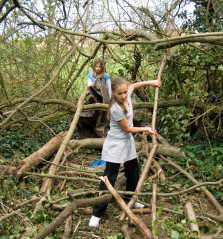
As your child grows older or if you have older children, building forts can be an age appropriate twist on the basic concepts of block building. Large sticks, logs and foliage are great natural material to build the perfect hide out. Using the same concepts of building, they exercise the movements of muscles and coordination while expressing their ideas. Team work is introduced with larger projects of fort building by working together to lift and balance heavier logs.


Whether you have young children or young adults there is something for everyone when it comes to building. With so many things to learn and adventures to have, why wait, get outside and build your own creation!